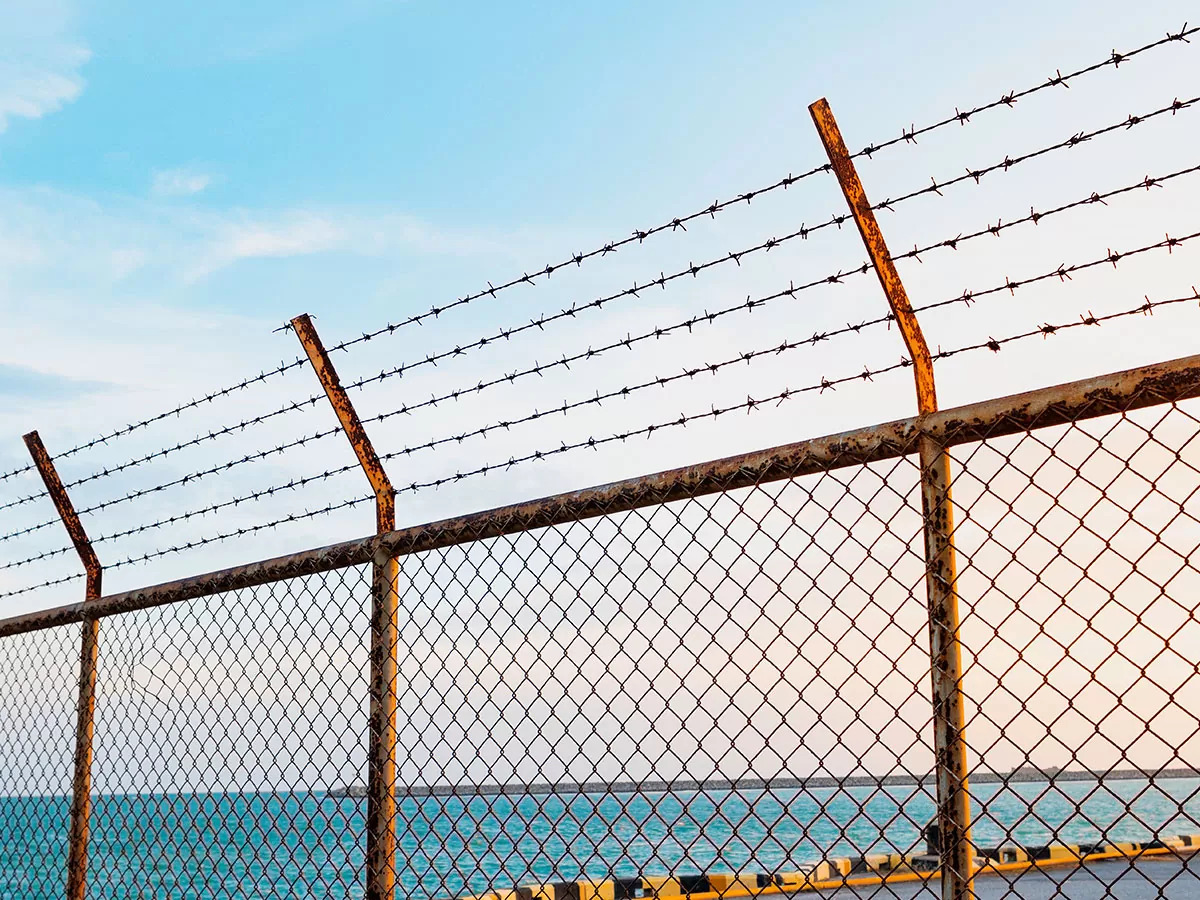
Adding barbed or razor wire to the top of a chainwire fence is one of the most cost effective ways to lift a perimeter from a boundary marker to a genuine deterrent. It is also one of the most misunderstood areas of fencing law in this state. Barbed wire fence regulations NSW are not a simple yes or no, and the answer that surprises most commercial clients is that even on an industrial site, adding security wire usually takes your fence out of exempt development. This guide explains what is permitted, where, at what height, and what approvals you need before you order a single coil.
Is barbed wire fencing legal in NSW?
Yes, barbed wire is legal. It is just not automatically approved. Under the State Environmental Planning Policy (Exempt and Complying Development Codes) 2008, one of the general requirements for a fence to qualify as exempt development is that it must not be electrical fencing or barbed wire in residential, industrial or business zones, except zone R5. Read that carefully, because the word most people skip is “industrial.”
What is the difference between barbed wire and razor wire?
They are often lumped together, but they behave very differently and attract different levels of scrutiny.
| Barbed wire | Razor wire | |
| Construction | Twisted steel strands with evenly spaced barbs | Sharp edged steel coils or tape, usually concertina or flat wrap |
| Primary effect | Deters and slows climbing | Snags, cuts and physically arrests climbing |
| Typical install | Two or three strands on angled extension arms | Coils on top of the fence, on arms, or on the ground as a secondary barrier |
| Injury risk | Puncture and scratch injuries | Severe laceration injuries |
| Typical application | General commercial and industrial perimeters, rural boundaries | Critical infrastructure, correctional facilities, utilities, restricted access zones |
| Approval difficulty | Moderate | High, particularly near residential or public areas |
In practical terms, barb wire is an effective and cost efficient option for general perimeter security, while razor wire offers a higher level of deterrence with its sharp edged coiled design, which makes it the preferred choice for critical infrastructure, detention facilities, utilities and sites requiring strict access control. Both can be installed as part of a new fence or retrofitted to an existing one. You can see the configurations we supply on our barb and razor wire chainwire page.
Can you install razor wire on a residential fence?
In almost every case, no. There is no single state law that names razor wire and bans it outright, but the practical outcome is close to a prohibition in residential settings. Razor wire is not exempt development, so consent is required, and councils very rarely support it on or adjoining residential land. Razor wire fence regulations Australia wide follow a similar pattern: it is designed to snag and tear, so it carries the tightest controls, and approval is commonly refused where the property adjoins a residential or townsite lot, where the fence sits close to a boundary, or where the wire would be at a height reachable from a public area.
Are there different rules for commercial and industrial properties?
The height entitlement is different. The barbed wire rule is not. Commercial and industrial sites get meaningfully more room for the fence itself. Fences in business and industrial zones can be up to three metres, or 1.2 metres if masonry, and where the lot adjoins a residential zone at least 75 per cent of the fence above 1.8 metres must be transparent. Where the fence runs along or within the setback of a road, at least 75 per cent of the fence above 1.2 metres must be transparent.
Do you need council approval for barbed wire fencing?
Yes, in residential, business and industrial zones. The pathway is either a Complying Development Certificate from a private certifier or a Development Application to council, depending on whether the proposal fits the complying development standards. For a fuller breakdown of what is and is not exempt, see our guide to chainwire fence height and Australian standards in NSW.
What height does a chainwire fence need to be before adding security wire?
There is no single state number, so this is governed by a combination of council DCP controls, the overall height cap for your zone, and practical security design.
The working rules our crews apply:
- The lowest strand should sit well above head height. As a general benchmark, security wire is installed so the bottom strand is at least two metres above ground level so it cannot be reached, caught or fallen into by someone passing the fence. Some councils are prescriptive about this figure.
- Count the topping in your total height. A three strand angled extension arm typically adds around 400 to 500 millimetres. Fit that to a 2.4 metre fence and you are near 2.9 metres overall, which sits under the three metre business and industrial cap but leaves little margin. On a 3.0 metre fence, the topping pushes you over the exempt limit even before the barbed wire prohibition is considered.
- The fence has to be worth topping. Security wire on a 1.8 metre light duty fence achieves very little. A climber is over the fabric before the topping matters. The sequence should be height, then gauge, then topping.
The practical sweet spot for most commercial and industrial sites in Sydney is a 2.4 metre chainwire fence in heavy duty 3.15 millimetre fabric with a three strand barbed extension, assessed and approved, giving roughly 2.85 metres of effective barrier.
The common thread is high value or high risk assets behind the fence, a site that is unattended outside business hours, and a perimeter that does not adjoin residential properties. Where a site does adjoin housing, expect the transparency requirement above 1.8 metres to apply and expect council to scrutinise any topping closely.
Longain Fencing has delivered chainwire security fencing for industrial sites, utilities, councils and government clients across Sydney for over 20 years. We will tell you what your zoning actually allows, specify the right fabric and topping for the risk, and flag the approval pathway before you commit.
Explore our barb and razor wire options and commercial fencing services, or call 1300 816 166 and request a free quote.
This article is general information only and current at the time of writing. Planning controls vary between councils and change over time. Confirm requirements with your local council or a private certifier before installing any security topping.