Chainwire Fence Height Rules in NSW: What Every Installer (and Homeowner) Gets Wrong
Before you install a chainwire fence in Sydney or anywhere across NSW, the first question worth answering is not “how much will it cost” but “how high am I actually allowed to go?” Height is the single control that decides whether your fence sails through as exempt development or lands you in a development application, and it changes depending on your zoning, where the fence sits on the block, and what the fence is there to do.
This guide covers chainwire fence height NSW rules, the chainwire fencing Australian standards that govern how the fence is built, and when chainwire fence council approval is genuinely required. If you’d rather have this assessed for your specific site, get in touch with Longain Fencing.
How High Can a Chainwire Fence Be in NSW?
There is no single national number. Chain link fence height regulations in Australia are set state by state, and in NSW they sit in the State Environmental Planning Policy (Exempt and Complying Development Codes) 2008, commonly called the Codes SEPP. Get inside those numbers and you generally need no approval at all. Step outside them and you need a Complying Development Certificate or a full DA.
Residential Zones (R1, R2, R3, R4 and RU5)
Side and rear boundary fences must not exceed 1.8 metres, or 1.2 metres if the fence is masonry. Fences along the boundary of, or within the setback area of, a primary or secondary road must not be taller than 1.2 metres, which includes the front of the site and any side boundary on corner blocks. Fences on or within the setback to a secondary road must also be at least 20 per cent transparent above 400 millimetres, with no solid piers or posts wider than 350 millimetres.
For chainwire, the transparency test is the easy part. Open mesh is effectively 100 per cent transparent, so a chainwire fence clears the openness requirement that catches solid Colorbond and rendered masonry front fences. Height is the binding constraint, not visibility.
Business, Industrial and Employment Zones
Commercial and industrial sites get significantly more room, which is why chainwire is the default perimeter product for warehouses, depots, yards and utility sites. Fences in business and industrial zones must not be higher than three metres, or 1.2 metres for masonry. Where the lot adjoins a residential zone, at least 75 per cent of the fence above 1.8 metres must be transparent. Where the fence is along the boundary with or within the setback of a road, at least 75 per cent of the fence above 1.2 metres must be transparent.
Again, chainwire passes the transparency tests comfortably. A 2.4 metre or 3.0 metre chainwire perimeter next to a residential zone is far easier to get away as exempt development than a solid panel fence of the same height.
Rural, Environmental and R5 Zones
In rural and environmental protection zones and zone R5, fences must not exceed 1.8 metres and must be constructed using post and wire or post and rail, with masonry permitted only within three metres either side of the entrance from the primary road.
Does Chainwire Fencing Require Council Approval?
Chainwire fencing usually doesn’t need approval if it meets exempt development rules (height, gate direction, bushfire materials, no barbed wire or electric fencing in most zones). Approval is needed instead if the Dividing Fences Act applies, work doesn’t meet the Building Code, the fence is on public land, or the site has heritage, flood, or foreshore restrictions, and adding barbed wire can void an otherwise exempt fence’s status.
What Height Chainwire Fence Is Best for Security?
For genuine security, specify heavy duty 3.15mm fabric rather than 2.5mm light duty, consider a reduced aperture or fusion bonded mesh to resist cutting and climbing, and add a top rail or three strand extension arm where the zoning allows it. A 2.4 metre fence in heavy gauge wire with a properly braced and footed post line will outperform a 3 metre fence built in light duty fabric on undersized posts every time. Check out our chainwire fencing range, covering railless boundary systems through to reinforced top and bottom rail configurations with matching gates.
How Does Fence Height Change on Sloping Blocks?
This is where most compliance disputes begin, because height is measured from existing ground level at every point, not averaged across the run. Drop the land away under a nominally 1.8 metre fence and the vertical dimension at the low end can exceed the limit.
NSW builds in a specific allowance for this. Where a fence behind the building line is on a sloping site and stepped to accommodate the fall in the land, it may be no higher than 2.2 metres above existing ground level at each step. That concession applies behind the building line only, so it does not rescue an over height front fence.
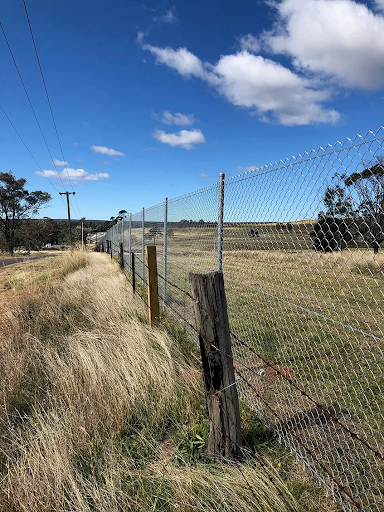
Chainwire is well suited to sloping ground because the fabric can be raked to follow the contour rather than stepped, which removes the triangular gaps under stepped panels. On steeper falls, a stepped installation with tight bottom wire and close post spacing is usually the better result. Either way, the ground profile should be confirmed on site before the post line is set out.
Planning a Chainwire Fence in Sydney or Across NSW?
Longain Fencing has installed chainwire for schools, councils, industrial sites and residential clients across Sydney for over 20 years, and every installation is set out to meet Australian standards and the relevant council requirements. We will confirm your zoning, your height entitlement and the right fabric specification before a single post goes in the ground.
Explore our chainwire fencing options, commercial fencing services and residential fencing services, or call 1300 816 166 and request a free quote.
This article is general information only and current at the time of writing. Planning controls vary between councils and change over time. Confirm requirements with your local council or a private certifier before installing.