Sloping ground is where fencing quotes diverge the most, and where the difference between a good installer and a cheap one shows up within the first year. Chainwire fencing on slope is actually easier to get right than most materials, because the mesh itself can be worked to follow the ground rather than forced into rigid panels. That flexibility is the reason chainwire is the default choice on rural blocks, bush sites, industrial yards cut into grade and any Sydney property where the land does not sit flat. This guide covers how it is done, when to step and when to rake, how gaps underneath are controlled, and what a slope realistically adds to the cost.
Can chainwire fencing be installed on sloping land?
Yes, and it handles grade better than almost any other fencing material.
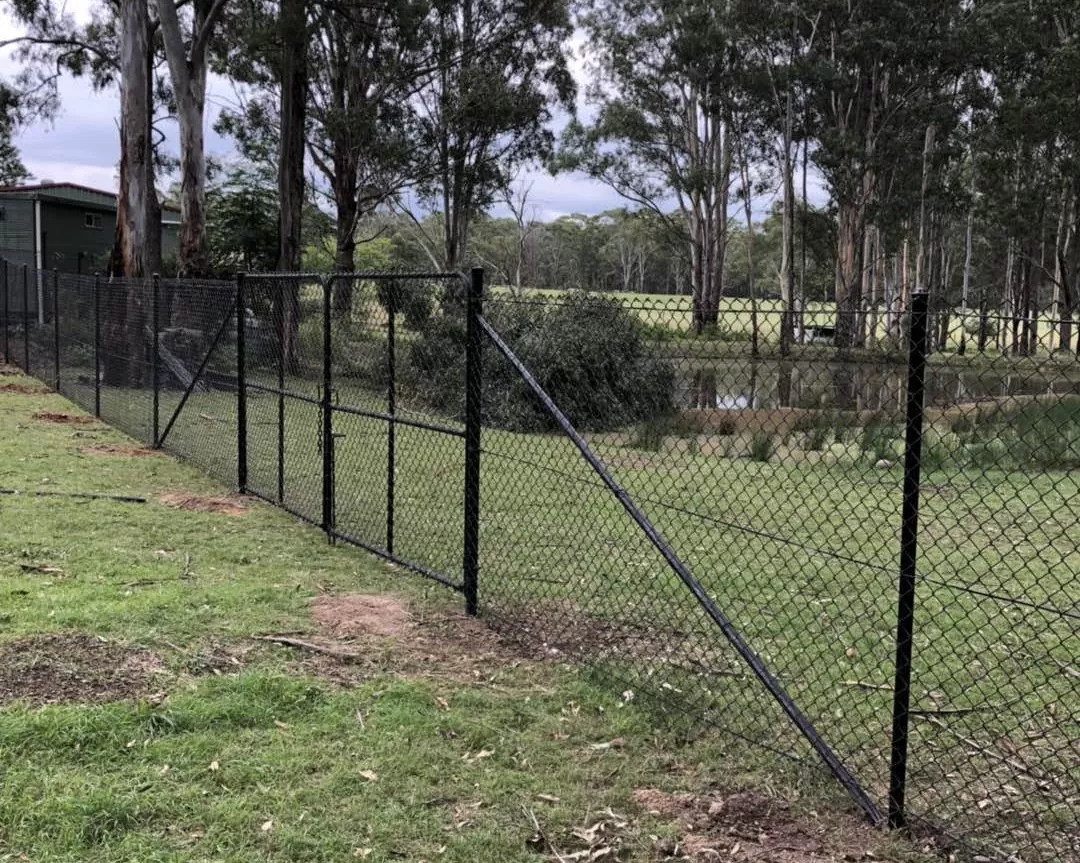
The reason comes down to the fabric. Chainwire is a diamond weave that can be skewed along its length, so the mesh can be laid to follow a falling contour while the top and bottom lines stay parallel to the ground. A Colorbond or timber paling fence is made of rigid vertical panels, so on a slope it has to be stepped, and every step leaves a triangular gap underneath. Chainwire has no such constraint on moderate grades.
That said, “can be installed” and “installed properly” are different things. Sloping ground changes post depth, post spacing, bracing, tensioning and the way the bottom of the fence is finished. A crew that installs a sloping run exactly the way they install a flat one will produce a fence that sags at the low points and lifts at the high ones.
Should chainwire fencing be stepped or raked?
The fence is built in level sections, with each section dropping down from the previous one at a post. The top line forms a staircase.
Best for: steep grades, sharp changes in level, terraced sites, and anywhere a rigid top and bottom rail system is being used.
Advantages: handles severe grade, works with rail systems, gives a defined architectural line.
Limitations: every step creates a triangular gap at the bottom of the panel that must be closed, and overall height varies along the run.
How do installers prevent gaps underneath the fence?
Gaps at ground level are the most common complaint on sloping fences, and they matter for three reasons: security, animal containment and appearance.
The methods, roughly in order of cost:
- Raking instead of stepping. The simplest fix is to avoid creating the gap in the first place. A raked fence follows the ground and closes naturally.
- Bottom tension wire. A tensioned wire threaded through the bottom of the fabric and strained between posts pulls the mesh down to the ground profile and stops it being lifted.
- Bottom rail. A horizontal rail at the base holds the fabric in a straight line and resists lifting. Our top and bottom rail systems are frequently specified for exactly this reason on uneven commercial sites.
- Oversized fabric raked to ground. Ordering mesh taller than the nominal fence height so the excess can be run down into the low points rather than leaving a void.
- Ground pins or stakes. Steel pins driven through the bottom of the mesh at intervals to hold it to the contour on undulating ground.
- Buried mesh or skirting. The fabric is turned out or down and buried 150mm to 300mm below grade. Essential where the fence has to contain or exclude dogs, foxes, rabbits or livestock.
- Concrete mow strip or plinth. A poured concrete strip along the fence line that gives a clean, permanent level base, closes gaps and removes the need to whipper snipper under the fence. The most expensive option and the most durable.
How are fence posts positioned on uneven ground?
Posts do more work on a slope than on the flat, and the setout changes accordingly.
Posts stay vertical, always. Posts are plumbed to true vertical, not set perpendicular to the slope. A post leaning with the grade is a post that will keep leaning.
Post spacing tightens. AS 1725 sets intermediate posts at consistent intervals along the fence line at a maximum of 3300mm. On sloping ground, spacing is commonly reduced below that maximum, because closer posts give the fabric more support points and let the fence track an irregular contour more accurately.
Footings go deeper on the downhill side. Soil on a slope provides less lateral resistance than soil on level ground, and the downhill face of a footing has less material holding it. Footings on grade are typically deeper and wider than on a flat run, particularly for strainer and gate posts.
Strainer and terminal posts carry more load. Tension in a fence on grade has a downhill component. End posts, corner posts and posts at any change of direction or gradient need to be strained and braced properly, with diagonal stays or tension cables as required for the system. AS 1725.1 specifically covers bracing diagonal stays for fencing without a top rail.
Changes of grade get a post. Every point where the slope angle changes noticeably should have a post, not just a continuation of the fabric. Without one, the fence bridges the break and leaves a gap or an unsupported span.
Ground conditions drive the method. Sydney sandstone shelf, reactive clay, loose fill and rock all demand different excavation and footing approaches. Rock may require coring or rock anchors. Soft or filled ground may require deeper or wider footings.
Does a sloping block increase fencing costs?
Yes, generally. The material cost per metre is similar, but the labour and site cost is higher. What drives the increase:
- More posts. Tighter spacing and additional posts at grade changes means more tube, more concrete and more holes.
- Deeper and wider footings. More excavation, more concrete, more spoil to remove.
- Harder excavation. Rock, tree roots and unstable fill all slow post holes down significantly. Sydney sandstone is a common cost driver.
- Restricted machinery access. If an auger or mini excavator cannot get to the fence line, holes are dug by hand. This is the single biggest cost variable on steep residential blocks.
- Slower setout and tensioning. Raking mesh to a contour and tensioning it evenly takes more time than a flat run.
- Gap treatment. Bottom rails, buried mesh or a concrete plinth all add cost.
- Additional materials. Retaining, terracing or regrading, where the site needs it, sits outside the fencing scope entirely.
As a general guide, expect a moderately sloping job to cost somewhat more than an equivalent flat run, and a steep, rocky, no-access job to cost substantially more. The honest way to price it is a site inspection. Anyone quoting a steep block by metre rate over the phone is guessing.
Worth noting on the other side of the ledger: chainwire remains the lowest cost per metre option for securing a large perimeter, so even with a slope loading it usually still comes in well under Colorbond, timber or palisade on the same run.
Can gates be installed on a slope?
Yes, but the gate needs more planning than the fence.
Swing gates are the problem child. A swing gate travels in an arc, and if the ground rises through that arc, the leaf will bind. Options:
- Build a level pad or landing at the gate so the gate opens over flat ground
- Increase ground clearance under the leaf, accepting a larger gap
- Use rising butt hinges that lift the gate as it opens
- Hang the gate to swing downhill rather than uphill
Sliding gates handle slope better. A sliding gate travels laterally across the fence line rather than swinging over the ground, so a consistent crossfall is much easier to accommodate. On uneven or unsealed ground, a cantilever sliding gate is the strongest option because there is no ground track to foul with debris or to sit unevenly.
Gate posts need more, not less. Gate posts on a slope carry the gate weight plus the lateral load of the fence tension, on ground with reduced resistance. Larger diameter posts with deeper footings are not optional here.
Set the threshold level. Even on a sloping site, the ground immediately at the gate opening should be as level as practical. This is where the gate latches, where vehicles cross, and where an uneven surface causes the most ongoing trouble.
What is the best fencing solution for uneven properties?
Chainwire, in most cases, and for structural reasons rather than marketing ones.
- It follows the ground. Diamond mesh can be raked to a contour, which no panel system can do.
- Wind passes through it. On exposed ridges and elevated blocks, an open mesh fence carries a fraction of the wind load of a solid fence, so posts and footings are not fighting a sail.
- It is repairable in sections. Ground movement is more likely on sloping sites. Chainwire can be re-tensioned or repaired panel by panel rather than replacing a whole run.
- It is the lowest cost per metre over the long perimeters typical of sloping rural and industrial land.
- It is available railless or railed. Railless chainwire rakes most easily and suits boundaries, rural land and work sites. Top rail and top and bottom rail systems give more rigidity where the site is stepped.
Where chainwire is not the answer: if the requirement is privacy, a stepped Colorbond fence with the step gaps properly infilled is the alternative, accepting the higher cost and the stepped appearance. If the slope is severe enough that the land itself needs to be held, that is a retaining wall question before it is a fencing question.
For rural and acreage properties on undulating land, our rural fencing systems are built specifically for long runs over changing terrain.
Fencing a sloping or uneven block in Sydney?
Longain Fencing has installed chainwire fencing across Sydney’s sandstone ridges, bush blocks, rural acreage and cut-and-fill industrial sites for over 20 years. We have handled jobs with difficult terrain, difficult access and heavy rock where machinery could not be used, and we will tell you upfront whether your run should be raked, stepped or both.
Explore our residential fencing and commercial fencing services, or call 1300 816 166 and request a free on site quote.