
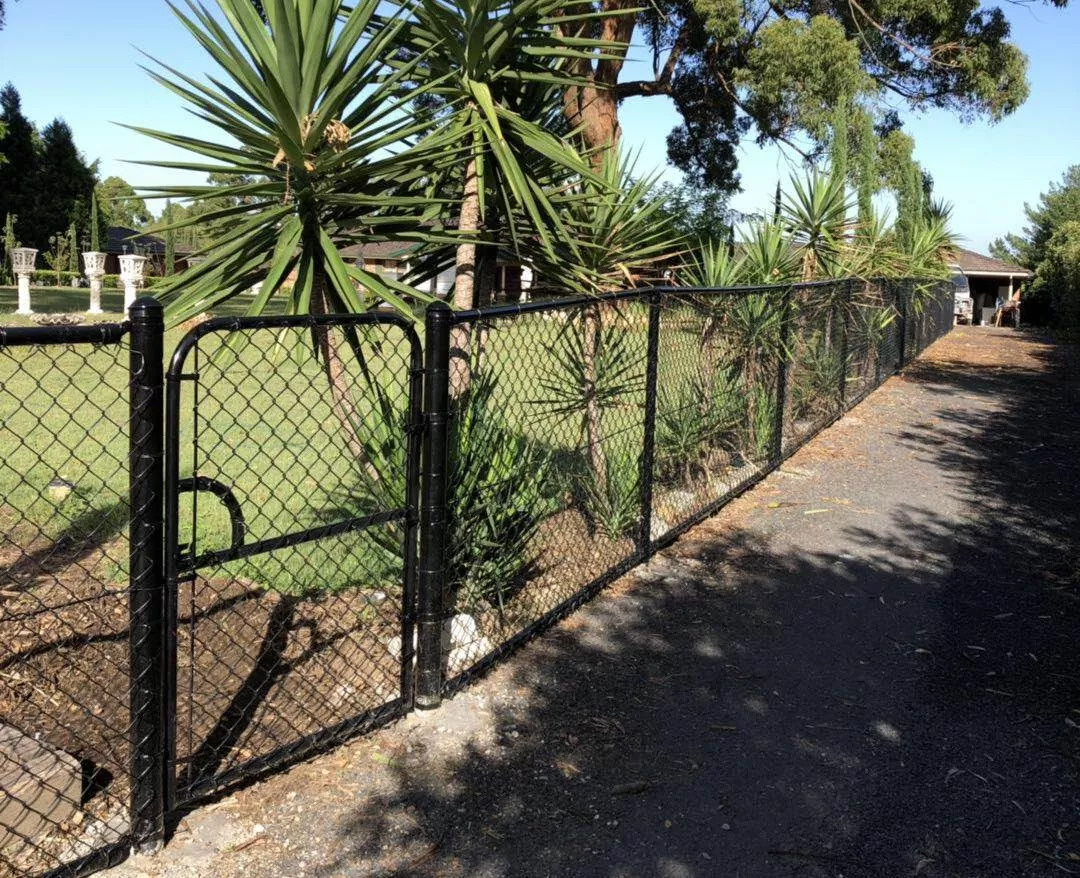
Chainwire Gates: Choosing the Right Type for Your Fence
A perimeter is only as strong as the way you get through it. The gate carries every load the rest of the fence doesn’t have to: daily traffic, wind, vehicle impact, lock hardware, and on commercial sites, an access control system. Get the type, size, and hardware right, and the gate outlasts the fence. Get it wrong, and within a couple of years you’re dealing with dragging bottoms and gates that no longer latch properly.
Gate types available
- Pedestrian gates – single leaf, typically 900mm to 1200mm wide, for staff entry and general foot traffic
- Single swing vehicle gates – one leaf covering the full opening, practical up to roughly 4 metres before weight and sag become an issue
- Double swing vehicle gates – two leaves meeting in the middle, each carrying half the span; the standard solution for most driveways and yard entries
- Sliding gates on track – a single leaf running on a ground track with guide rollers, suited to wide openings and windy sites
- Cantilever sliding gates – suspended on rollers off a support post structure with no ground track at all, the premium option where a track would fill with gravel, mud, or debris
- Bi-fold and trombone gates – folding or telescoping leaves for sites with a wide opening but very limited room to swing or slide
- Emergency egress gates – secondary gates required for evacuation routes and fire brigade access on larger sites
These principles apply at smaller scale too, our chain wire and mesh storage cages use the same gate hardware logic.
Swing vs. sliding
The choice usually comes down to space, opening width, and how often the gate cycles. Swing gates suit standard driveways, residential and light commercial sites, and anywhere you have clear level ground with room for the arc, best up to about 4m single or 8m double. Sliding gates handle wide industrial openings (4m to 12m and beyond), sloping or uneven ground, and high traffic entries that will be automated. Cantilever gates are the right call on unsealed yards, waste and recycling facilities, and anywhere heavy vehicles cross the threshold.
One compliance point applies specifically to swing gates: under NSW exempt development standards, gates must not open outwards. If a gate swings over a footpath or road reserve, it isn’t exempt and may need separate approval.
Driveway gate essentials
The hinge side carries the gate’s entire weight, so frame gauge, gate posts, footings, and bracing all need to step up from standard fence specs, undersized posts and shallow footings are the most common point of failure on cheap installations. Where the gate forms part of a security perimeter, it should match the fence specification rather than undercut it. Our top and bottom rail chainwire systems are frequently paired with matching vehicle gates for exactly this reason. On sloping driveways, a sliding gate avoids the binding a swing gate would cause.
Automation
Sliding gates are generally the easier and more reliable candidate for automation, rack and pinion motors handle wide, heavy leaves well and cycle quickly. Swing gates use ram or articulated arm operators, practical up to around 3 to 4 metres before wind loading and leaf weight become limiting factors. Automation adds heavier posts and footings, power and conduit runs, safety beams, obstruction detection, manual release for power failures, and ideally battery backup.
Adding a gate to an existing fence
Usually straightforward: cut the fabric at the chosen location, install purpose-sized gate posts with new footings, re-tension the fabric either side, and hang the gate matched to the existing height, mesh size, and coating.
Commercial applications
- Logistics/warehousing: automated cantilever sliding gate for vehicles, separate pedestrian gate with access control, plus emergency egress
- Construction sites: heavy duty double swing gates, often with simple chain and padlock
- Utilities/government: heavy duty sliding gates with barb or razor wire continued unbroken across the gate
- Schools/councils: self-closing pedestrian gates plus double swing gates for maintenance access
- Waste/recycling: cantilever gates, since ground tracks fill with debris within weeks
The gate should never be the weakest part of the perimeter. See our commercial fencing services for the full scope.
Compliance checklist
- Gates must swing inward, not outward over public land
- Match fence height rules for your zone (1.8m residential rear, 1.2m front, up to 3m industrial)
- AS 1725.1 covers gate posts, locking, and coatings, not just the fence
- Anything over public land needs approval under the Roads Act 1993 and Local Government Act 1993
- Standard chainwire is not a valid pool barrier; use purpose-built pool fencing and gate hardware
Need a gate specified for your site?
Longain Fencing supplies and installs chainwire gates across Sydney and NSW. Call 1300 816 166 or request a free quote.