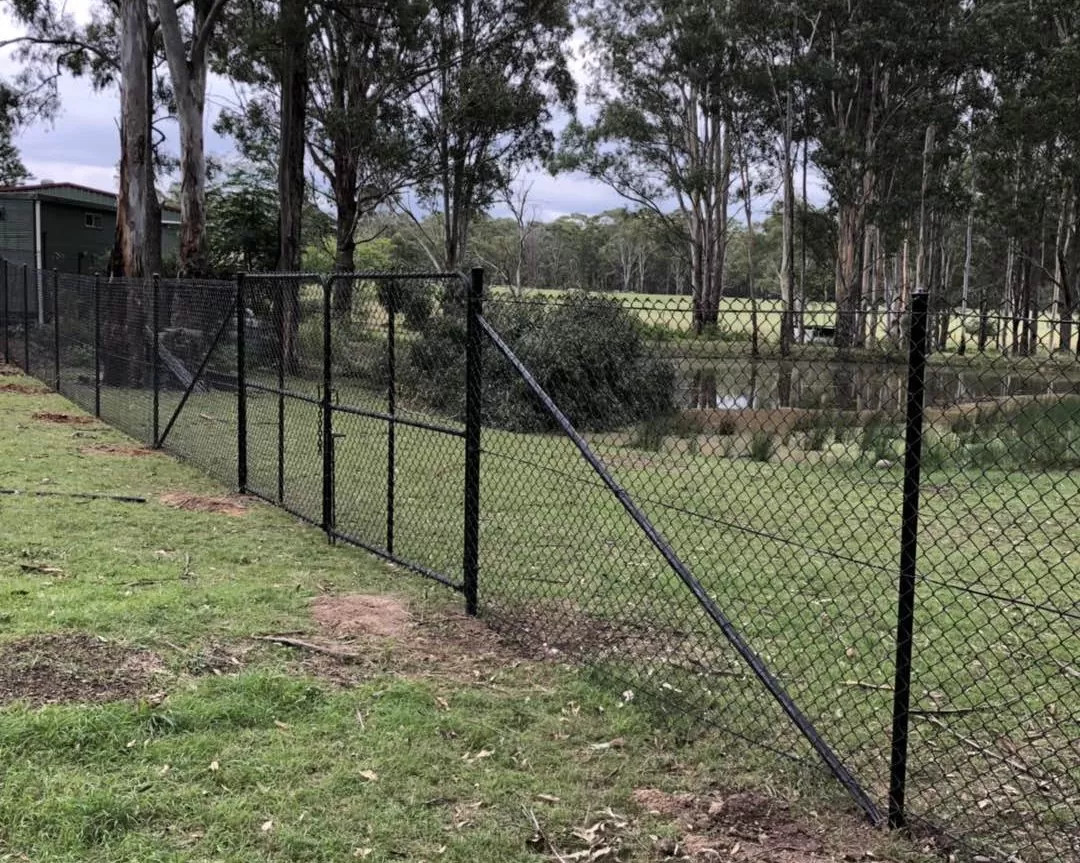
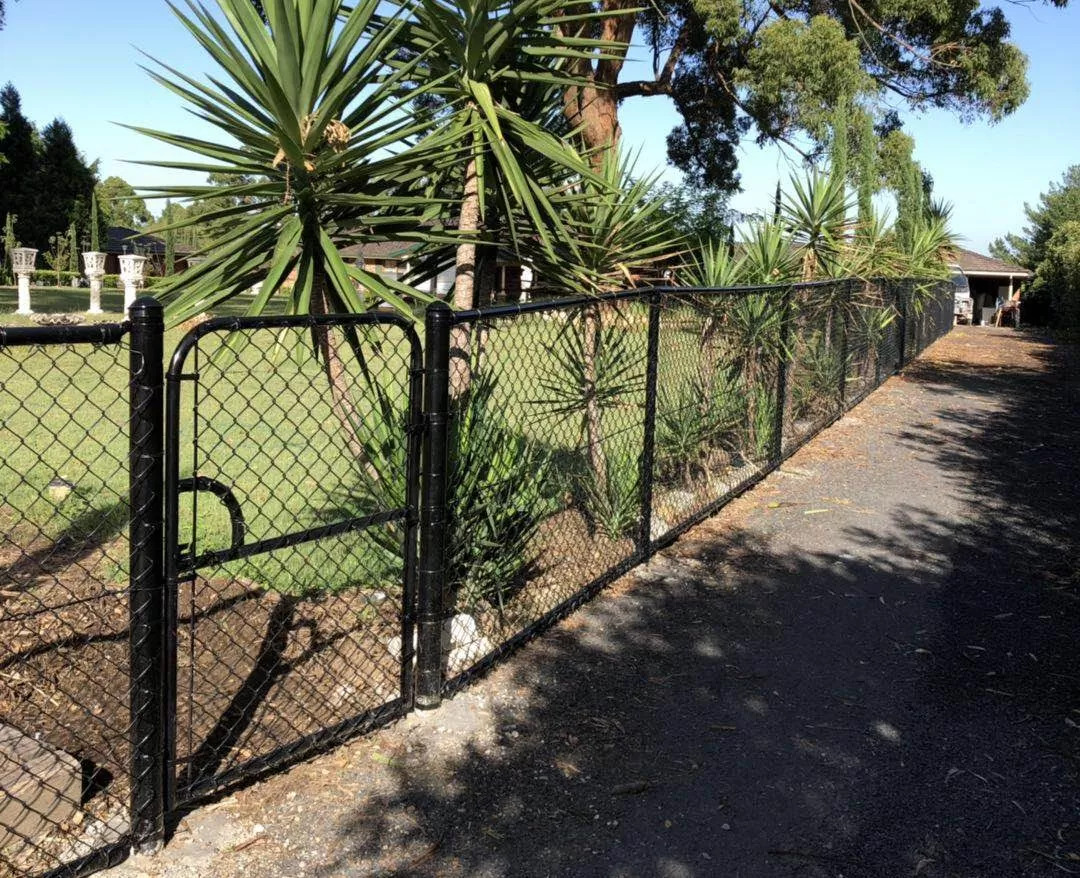
A chainwire fence almost never fails in the middle of a run. It fails at the gate.
The reason is structural. A fence distributes its load across every post along the line. A gate concentrates the entire weight of a swinging or rolling leaf onto one or two posts, and then adds the shock of that leaf being slammed, kicked, reversed into and hung off, several times a day, for twenty years. A 6 metre double gate at 2.4m high weighs something like 180kg per pair of leaves. Every gram of that is carried by two posts and the concrete around them.
This guide covers every gate type used in chainwire fencing, how to choose between them, how to size the posts and footings that actually hold them up, what the hardware should be, and what the whole thing costs in Sydney in 2026.
What three questions decide which gate you need?
Width, space and threshold. Answer those three and the gate type picks itself.
1. How wide is the opening?
Past about 4 metres a single swing leaf becomes unmanageable, and past about 8 metres a double becomes impractical. That is where sliding takes over.
2. What space is available on the inside?
A swing gate needs a clear arc. A ground-track sliding gate needs a backrun roughly equal to the opening. A cantilever needs a backrun of roughly 1.3 to 1.5 times the opening, because the counterbalance tail has to sit behind the posts. Many sites that reject sliding gates do so for this reason alone.
3. Is the threshold level and clean?
Ground-track sliding gates are cheaper and simpler, but the track must stay clear of gravel, mud, leaves and grit, and it must be flat. On a sloping or trafficked threshold, cantilever is the only sliding option that works.
What does chainwire change about gate selection?
Chainwire leaves are light, and that has three practical consequences for how big a gate you can build.
Mesh weighs a fraction of a Colorbond sheet or a timber infill, and wind passes straight through it. So swing gates can span wider before they sag, posts can be a size smaller than an equivalent solid gate, and automation motors can be smaller and cheaper. A 4 metre chainwire swing leaf is a sensible thing to build. A 4 metre Colorbond one is not.
If you are still deciding on heights, mesh aperture and wire gauge, that detail sits in our chainwire fence specification guide.
How do you choose the right gate type?
Work down the questions in order. The first yes gives you the answer, and every question is about the site rather than the budget, because the site rules out options the budget cannot rescue.
- Is it a person, a bin or a mower getting through, rather than a vehicle?Pedestrian gate. 0.9m to 1.2m opening. This is your answer and nothing else applies.
- Is the opening under 4 metres, with a clear level arc on the inside?Single swing gate. Inward swinging. The cheapest way to close a driveway-width gap.
- Is the opening 3 to 8 metres, with clear level arcs on both sides?Double swing gate. Two leaves meeting in the middle, which halves the leverage on each hinge post.
- No room to swing, but the threshold is flat, sealed and swept clean?Ground-track sliding gate. Cheaper than cantilever and perfectly good where nothing can get into the rail.
- No room to swing, and the threshold slopes, is unsealed, or gets driven across?Cantilever sliding gate. The only sliding gate that works here. Needs a backrun of 1.3 to 1.5 times the opening.
- No swing arc and no backrun either?Bi-fold, bi-parting, or a site redesign. This is where specialist money goes in, or where the fence line moves.
The question people skip is the backrun. A sliding gate has to go somewhere when it opens, and on a cantilever that somewhere is 1.3 to 1.5 times the opening width, measured back along the inside of the fence line, clear of parking, planting and anything stacked against the fence. Measure it before you fall in love with a sliding gate.
Ground clearance
Specify 50mm to 75mm under the gate. Less and it drags on the first bit of settlement or a stone. More and a small dog gets under it, which matters if containment is the point. On a sloping threshold, the clearance must be measured at the high point of the arc, not at the closed position, or the gate will bind as it opens. Our guide to installing chainwire fencing on sloping or uneven land covers the threshold side of this.
Accessibility
If the gate is on an accessible path of travel, for a school, childcare centre, public site or any building subject to accessibility requirements, the clear opening and the latch operation both matter. A clear opening of at least 850mm and a latch that can be operated with a closed fist, without tight grasping or twisting, is the general expectation. Check the specific requirement for your building class rather than assuming.
Where to put it
Put pedestrian gates where people already walk, not where the fence line is convenient. A gate 8 metres from the natural desire line gets ignored and the fence gets climbed instead. On school and council sites this is the most common cause of damaged mesh next to a gate.
Single swing gates: how wide can one go?
A single leaf covering the whole opening is simple and cheap, and limited by physics: every extra metre of width multiplies the leverage on the hinge post.
The swing arc is bigger than people expect
A 3.5m gate swinging 90 degrees sweeps a quarter circle of 3.5m radius. That is 9.6 square metres of ground that has to stay clear of cars, bins, planting, parked trailers and anything else. If the gate opens outward onto a footpath or road, it is almost certainly not permitted, and if it opens inward onto a driveway, the car has to stop 4 metres back to let it open.
This is why so many driveway swing gates end up permanently propped open. The arc was never really available.
Ground fall is the other constraint
A swing gate sweeps a level arc. If the ground rises across that arc, the gate jams. If it falls, the gap under the gate grows as it opens. On any threshold with more than about 50mm of fall across the swing, you need either a rising-butt hinge arrangement, a gate cut to follow the slope at the expense of the closed-position clearance, or a sliding gate instead.
A rule of thumb: stand at the hinge post, look across the arc, and if you can see the ground change level, get the contractor to measure it before quoting a swing gate.
Which way should it swing?
Inward, almost always. An outward-swinging gate onto a public footpath is a hazard and usually prohibited. Inward also means the gate is pulled closed by its own weight if the hinge pin settles slightly, rather than drifting open.
The exception is an emergency egress gate, which must swing in the direction of escape. If a gate serves as a fire exit from a yard or a sports facility, it opens outward and it cannot be padlocked from the inside.
Where single swing gates earn their place
Side access on a residential block, pedestrian-plus-mower openings on schools and parks, and light vehicle access on rural and semi-rural properties where there is unlimited room for the arc and nobody minds getting out of the ute to open it.
Double swing gates: how are they held shut?
Two leaves meeting in the middle is the standard answer for driveways and yard entries between 3 and 8 metres, because splitting the opening halves the leverage on each hinge post.
Three things hold a double gate shut, and a quote should name all three
A drop bolt on the first leaf, dropping into a ground socket at the centre of the opening. This is what the second leaf latches against, and it is what stops the pair being pushed inward.
A centre stop, either a small upstand at the socket or a rebated meeting edge, that stops the leaves swinging past each other.
A latch or lock joining the two leaves at the meeting edge.
The ground socket is the piece most often done badly. It should be a proper sleeved socket set in the concrete, not a hole drilled in the driveway, because an unsleeved hole fills with grit and the bolt stops dropping within a season. Where the threshold cannot take a socket, for example on a busy vehicle crossing, use a surface-mounted centre stop with a slam latch instead.
Why double gates sag, and what prevents it
Each leaf is a cantilever. The weight at the latch edge tries to rotate the leaf downward about its hinges, and the leaf resists that only through its diagonal brace. A frame with no diagonal, or with a loose cable brace, drops at the latch edge until the two leaves no longer meet, which usually presents as the drop bolt missing its socket by 20 or 30 millimetres.
The fix is cheap at build time and expensive later. Specify a tensioned cable brace with a turnbuckle in each leaf, running from the top hinge corner down to the bottom latch corner, and have the turnbuckles accessible so they can be tightened once in the first year as everything beds in. If yours has already dropped, our guide to sagging chain wire fences covers the diagnosis.
The arc problem on driveways
Two 3 metre leaves on a 6 metre opening sweep two quarter circles of 3 metre radius, which is roughly 14 square metres of driveway that must stay empty. On a tight Sydney block there is often no such space, and this is the single most common reason a site that looks like a double-gate job turns out to be a sliding-gate job.
Check this before you quote: measure from the gate posts back along the driveway, and confirm nothing permanent sits inside the radius, including the garage door swing, a letterbox, a meter box, a bin store or a street tree.
Sliding gates: ground track or cantilever?
The gate rolls sideways instead of swinging. It needs no arc, which is why it dominates commercial and industrial sites, and it comes in two quite different forms that are often confused in quotes.
Ground track
A steel rail is set into or onto the threshold, and the gate rolls along it on grooved wheels, with guide rollers on posts keeping it upright. It is cheaper, mechanically simpler and perfectly good where the threshold is sealed, level and swept.
It fails in exactly one way: something gets into the track. On an unsealed yard, a construction site, a landscape supply yard or anywhere with gravel, the track jams within weeks. On a site with vehicle traffic across the track, the rail gets bent. If any of those apply, you want a cantilever, and paying for ground track instead is a false economy you will discover within a month.
Cantilever
The gate has a tail extending back past the opening, carried on two roller carriages mounted on posts, with the leading end unsupported. Nothing crosses the opening at ground level at all.
The cost is space. The tail has to live somewhere, so the fence line behind the gate must be clear for roughly 1.3 to 1.5 times the opening width, and that run has to be straight, level and clear of parking, bins and planting. For a 6 metre opening, budget about 8.5 metres of clear backrun.
Cantilever posts also take serious loads, because they carry the entire gate weight at two points, with a prying moment as the gate runs out. Expect substantial footings, often a concrete beam rather than individual pads, and expect the quote to say so.
Why do chainwire gates suit sliding particularly well?
Because sliding gates are weight sensitive, and chainwire is the lightest infill you can hang on one.
Every kilogram has to be accelerated, carried on rollers and stopped. A chainwire infill weighs a fraction of a Colorbond or slat infill of the same size, and it offers almost no wind resistance, which matters on a 9 metre leaf in an exposed yard. A lighter leaf means a smaller motor, smaller carriages, smaller footings and a longer service life on every moving part.
What post and footing sizes does a chainwire gate need?
Under AS 1725.1, terminal posts including gate posts are a minimum of DN50 medium grade galvanised pipe, which is 60.3mm outside diameter with a 3.6mm wall. That is a minimum, not a target. Real sizing follows the leaf.
The hinge post is always heavier than the latch post, because it carries the weight. A quote that lists one gate post size for both is a quote written from a price list rather than a calculation.
Footings
As a general rule, a gate post footing is at least twice the volume of a line post footing at the same fence height. Concrete should be crowned above ground and sloped away so water sheds off the post rather than pooling around it. For line posts generally, see how far apart fence posts should be and how deep fence posts should be dug.
The curing mistake that ruins gates
A gate hung on concrete that has not cured will pull its post out of plumb, and the gate will never sit right again. Rapid-set concrete reaches workable strength in a few hours but not full strength for days. The correct sequence is: set the posts, let them cure, then hang the gate. If a crew sets posts and hangs gates in the same visit on a large gate, ask what concrete they used and how long they left it.
This is a genuinely common failure on fast-turnaround residential jobs, and the symptom appears three to six months later as a gate that has dropped and a post that leans toward the opening.
Bracing the hinge post
On anything over about 2.5 metres of leaf, the hinge post wants to rotate toward the opening under the gate’s weight. Three ways to stop it, in increasing order of effectiveness: a larger footing, which resists rotation through sheer mass and bearing area; a concrete thrust block, which is additional concrete cast on the side the post is being pulled toward; and a tie or strut back to the first line post, turning two posts into one braced frame.
On an 8 metre double gate or any cantilever, the third one is not optional.
What hardware should be specified on a chainwire gate?
Hardware is a small fraction of the gate cost and a large fraction of whether you are happy with it. Specify it rather than leaving it to whatever is in the installer’s van.
Hinges
The security detail worth knowing: a standard pin hinge lets the gate be lifted straight off the post. On any gate where that matters, invert the top hinge pin so the gate cannot be lifted, or fit an anti-lift collar. It costs almost nothing and it defeats the most common way a chainwire gate gets opened.
If the gate is locked, specify where the lock sits and how it is protected. A padlock hanging in the open gets attacked with bolt cutters; the same padlock inside a welded shroud does not. A shroud adds $80 to $200 and is the single cheapest security upgrade available on a gate.
Drop bolts and ground sockets
Specify a sleeved ground socket, not a drilled hole. The sleeve should be a short length of pipe cast into the concrete with a closed or draining bottom, so grit and water do not fill it. On a vehicle threshold, specify a flush cover plate or a surface stop instead.
Stops and bumpers
Every swing gate needs a stop at the fully open position, or the leaf eventually swings past 90 degrees, hits the fence, and bends the frame. A simple galvanised post set in concrete with a rubber bumper costs about $120 and prevents a $900 repair.
Hardware specification you can copy into a quote request: galvanised adjustable hinges with ball bearings, top hinge pin inverted for anti-lift. Lockable padbolt with welded padlock shroud. Sleeved ground socket for the drop bolt. Open-position stop post with rubber bumper. Cable brace with accessible turnbuckle in each leaf. All hardware galvanised to match the fence.
Can you automate a chainwire gate?
Yes, and it is cheaper than automating a solid gate, because the leaf is lighter and offers almost no wind resistance. It is still a significant line item, and it brings safety obligations.
What the cost actually includes
The motor is usually less than half of it. The rest is the control board, the safety devices, the access control, and the power.
Power run from the switchboard. This is the variable that moves the quote most. A gate 5 metres from a power point is cheap. A gate 60 metres down a driveway needs a trenched, conduited run and an electrician, and that alone can be $1,500 to $4,000.
Safety devices. Photoelectric beams across the opening at minimum, and usually safety edges on sliding gates. An automated gate is a powered machine that can crush, and these are not optional extras.
Access control. Remotes are cheap. Keypads, intercoms, video intercoms, card readers and number-plate recognition are not, and each adds cabling.
Battery backup. Worth having on any gate that is the only vehicle access. Without it, a power cut means the gate stays shut.
Safety is a real obligation, not a sales upsell
An automated gate is a powered door, and powered gates have injured and killed people, overwhelmingly children. The baseline expectations are force limitation so the gate stops and reverses when it meets an obstruction, photoelectric beams across the opening, and clearly marked manual release so someone can open it in a power failure or an emergency.
On any site with public or child access, including schools, childcare, strata and commercial car parks, treat safety devices and a documented commissioning test as mandatory, and get the installer to hand over the commissioning record.
When automation is not worth it
On a pedestrian gate, almost never. On a rural or back-of-site gate used twice a week, rarely. On a residential driveway used four times a day in the rain, usually yes. On a commercial yard with delivery traffic, always, because the alternative is a driver leaving a running truck to open a gate.
The retrofit trap
Automating an existing manual gate often costs more than it should, because the existing posts and footings were sized for a gate someone pushes, not for the repeated mechanical cycling and the motor mounting loads. Expect a good installer to assess the posts first and to tell you if they need upgrading. If an automation quote arrives without anyone having looked at the gate posts, be sceptical.
What compliance and safety rules apply to gates in NSW?
Gates attract more regulation than fences, because a gate is where people and vehicles actually interact with the barrier.
Pool barrier gates
If the gate forms part of a swimming pool barrier in NSW, it must be self-closing and self-latching, with the latch at the required height and the gate opening away from the pool, under AS 1926.1, with the applicable version depending on when the pool was built. Every pool and spa must also be on the NSW Swimming Pool Register.
Chainwire is generally unsuitable as a pool barrier because standard mesh is climbable, and a chainwire gate in a pool barrier line will usually fail certification. Do not design around this; get a certifier to confirm before you build.
Egress and fire exits
A gate that serves as an emergency exit from a yard, a sports facility, a school ground or a building’s path of travel must open in the direction of escape, must be openable from the inside without a key, and must not be padlocked shut during occupied hours. Chaining a yard gate shut because the site is secure is a common and serious breach, and it is the kind of thing that surfaces after an incident rather than before one.
Gates onto public land
A gate must not swing out over a footpath, nature strip or road. Beyond the obvious hazard, it is generally a council matter and you may be required to rehang or replace it. On a tight site this is a real constraint, and it is often the reason a residential driveway ends up with a sliding gate.
Construction site gates
Temporary site perimeters in NSW are built to AS 4687 for temporary fencing and hoardings. The practical requirements for gates are that the opening is controlled, the gate is braced against wind, it closes and secures outside working hours, and it does not open onto a footpath or carriageway without an approved traffic management arrangement. Councils vary on hoarding requirements where the site meets a public footpath, so check the development consent conditions rather than assuming standard temporary fencing is enough. Our construction site fencing guide covers the perimeter side.
Schools, childcare and council sites
Selvedge on the gate must be knuckled, not barbed, at every edge a child can reach. Self-closing and self-latching hardware is commonly required on perimeter gates at childcare centres. Gaps between the gate and the post, and under the gate, should be sized so a child cannot pass through or get a limb caught, with a 50mm to 75mm ground clearance and a snug latch stile as the practical targets. Finger-protection at the hinge side is worth specifying on any gate young children will use, and gates on an accessible path of travel need a clear opening and a latch operable with a closed fist.
Automated gates
An automated gate is powered plant. Force limitation, photoelectric beams, a clearly marked manual release and a documented commissioning test are the baseline on any site, and are non-negotiable where children or the public have access. Keep the commissioning record, and have the gate serviced annually.
For the height side of compliance, including exempt development limits, see chainwire fence height in NSW. For barbed and razor wire across a gate, see what is actually allowed in NSW.
Maintenance schedule
| Interval | |
|---|---|
| Every 3 months | Check the gate latches without being lifted or forced |
| Every 6 months | Grease hinges and rollers; hose salt off coastal gates |
| Every 6 months | Clear the ground track or socket on sliding and double gates |
| Annually | Check and tension the cable braces |
| Annually | Check gate posts for plumb and the footing for movement |
| Annually | Service automated gates, including a safety device test |
| Every 2 years | Check the mesh tension bars and bands in each leaf |
There is a broader routine in how to maintain chain wire fencing if you want the fence side as well as the gate side.
Chainwire gate FAQs
How wide can a chainwire swing gate be?
A single leaf is practical to about 4 metres and a double to about 8 metres. Chainwire goes wider than solid gates at the same post size, because the leaf is light and wind passes through. Beyond 8 metres, slide.
How much does a chainwire gate cost in Sydney?
A 0.9m pedestrian gate at 1.8m high runs $420 to $850 installed, a 4.5m double swing $1,400 to $2,700, and a 6m cantilever sliding gate $5,500 to $12,000. Sydney tables put gates across all fence types at $290 to $920 for a single and $920 to $2,875 for a double.
What size posts does a chainwire gate need?
AS 1725.1 sets a minimum of DN50 medium grade galvanised pipe for terminal posts including gate posts. In practice, size by leaf width: 50NB to 2 metres, 65NB to 3 metres, 80NB to 4 metres, with the hinge post always heavier than the latch post.
Why does my gate not latch any more?
Almost always the leaf has sagged, because the diagonal brace was never fitted or has gone slack. Check for a cable with a turnbuckle running from the top hinge corner to the bottom latch corner. If it is there, tension it. If it is not, that is the fix.
Sliding or swing for a driveway?
Swing if you have the arc and the ground is level. Sliding if you do not, which on tight Sydney blocks is most of the time. Measure the arc before deciding, including the garage door swing and anything parked inside it.
What is the difference between ground-track and cantilever sliding gates?
A ground-track gate runs on a rail across the opening; a cantilever gate has nothing crossing the opening and is carried on a counterbalanced tail behind the posts. Cantilever costs more and needs more backrun, but it is the only option on a sloping, unsealed or trafficked threshold.
How much backrun does a sliding gate need?
About one times the opening for a ground-track gate and 1.3 to 1.5 times for a cantilever. For a 6 metre opening, allow about 8.5 metres of clear, straight, level fence line behind the gate.
Can I automate an existing chainwire gate?
Often yes, but the posts and footings were sized for a gate someone pushes, not for repeated powered cycling and motor mounting loads. Expect a good installer to assess the posts first.
Can a chainwire gate be a pool gate?
Generally no. Pool barriers in NSW must comply with AS 1926.1 and standard chainwire mesh is climbable. Get a certifier to confirm before relying on one.
Need a gate that still latches in ten years, not two? Longain Fencing builds and installs chainwire gates across Sydney, sized properly from the leaf up, with the posts and footings specified rather than assumed.